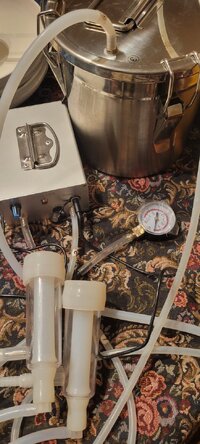
Large commercial dairy farms have lowered the psi on the milking vacuum to 12.5 to 13 from the previous 14-15 that they used to be set at. And the pulsation... on/ off is ESSENTIAL for proper milking. A milking machine actually works opposite of milking by hand.. when you hand milk, you "trap the milk" and work it down out of the teat...a machine actually lets the milk out of the teat by relaxing the pressure, as opposed to using pressure to squeeze it out...so pulsation is very important to allow the teat to fill and empty...
If you have a claw that is clear... watch the milk out of the inflation... the squeeze then release is a "close then open" type thing.. with the vacuum "pulling" the milk down as the "relax the pressure" happens... because it cannot trap the milk in the top of the teat and squeeze it out like when you hand milk... same idea, opposite method from hand milking to machine....since when you hand milk, you basically squeeze from the thumb/first finger and you walk down the hand, finger by finger in succession. You don't realize it so much because it is just natural response... I became very aware of it when I had that bad car wreck years ago... and the surgeries on my hand , and the therapy to get it working better... and hand milking the cow was better for me than any of the "squeezing the rubber ball" type stuff to build up strength and dexterity...
You know how you use your fingers to "drum them" on a table... succession from index to pinky??? That is essentially what hand milking is .... granted some teats only allow you to use a couple fingers sometimes... I had a first calf heifer that I could only use thumb and forefinger... it was miserable to milk her...
Since a machine cannot do that, it works on the opposite principle... squeeze shut, relax and vacuum pulls the milk down/out. Constant vacuum without the pulsation will damage the udder... and destroy the orifices/teat ends.