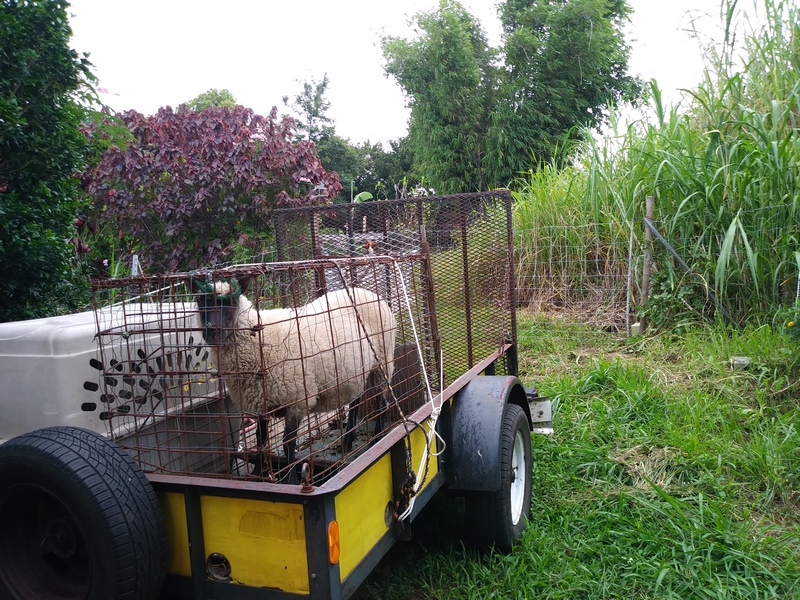
1. Wool sheep have wool coats that continue to grow like your own hair. Shedding sheep that shed out their wool grow new wool each year after shedding out the previous year's growth. You have woolies so if you don't shear them the wool will just continue to grow but the wool will be easier to work with if you shear annually.
Perfect! They can be sheared when the wool is long enough to use and it doesn't matter what their coat is doing like with rabbits. Hmm, the rabbits (English angora) molt like hair sheep, maybe it's something to do with the multiple layers of coats that creates the molting?
They don't seem to be on the same schedule, the ewe could be sheared while the ram is still kinda short. He's friendlier than she is, so it would be nice to practice with him first, but they both need to be sheared eventually.
2. The wool does not have to be dry to shear. When slick shearing for fairs we used to wash the sheep in dishwashing detergent to cut the lanolin for the fine blades. A full wet fleece would be difficult to work though, our Fair lambs usually only carried 5-6 months of baby wool at most.
"Slick shearing"? Shearing to bare naked? Prewashing the wool and maybe even dying them with some sort of cold dye would possibly be fun (is Kool-Aid a colorfast dye?), but I don't think the sheep would approve.
3. Wool fleeces MUST be dry to pack in the wool sacks to store, like Purplequeenvt says, or it will mildew and rot in the sack. And don't use plastic bags to store the wool. You can make fabric bags out of old sheets or use old pillow cases as wool sacks.
The first few fleeces will probably be spun up right away. If they're sheared on a different schedule, then there would only be one fleece at a time, too! Ha! Maybe they'll get sheared when I need more wool to spin? If it's spun really fat for a rug, the sheep will be naked all the time.
4. Your breeder chose Clun sheep because they do better in very wet climates. Some sheep have wool fleeces that part along the spine when they get long. This can allow icy rain or snow to reach the sheep's skin causing problems. Because of your climate in Hawaii the breeder was probably more worried about wet weather for health reasons and hoof problems, etc.
They do seem to have almost a 'part' at the spine when they're wet. The wool still stays upright, but not really dense along the spine. I may shear them so the fleece is in two pieces. Since it's just for my own use, if it's not all in one big fleece it's okay.
5. Smaller sheep look like they would be easier to manage, but you will get tired of the constant bending over to deal with any problems, or trim feet. Since your sheeo seem to be tame, a large sheep can learn to lead in a halter which will make their care easier on you.
They came with collars, but the shepherdess told me they'd grow out of them pretty soon. Which they did. A halter would be around their head which doesn't have as much wool as their necks so it shouldn't be needing adjustments very often. Would they wear the halters all the time? At the moment, they can be lead with a tin can. Soon as they see it, they're running over to see if there's alfalfa pellets.
6. If you want the wool for spinning, you should shear once a year only. Shearing twice a year results in shorter wool lengths which makes spinning more difficult. Fleeces sold commercially are discounted for "second cuts" and too many short fibers.
Anything over 1-1/2" (4cm) is long enough but 3"-4" (8-10cm) would be nicer. The usual spinning fibers around here are English angora (rabbit) and Bleak Hall Sea Island White cotton. Those are both in the 1-1/2" - 3" (4cm - 8cm) range. Wool is a lot easier to spin.
7. Cheviots have a reputation as being flighty, nervous, and less docile than the average sheep, so you probably made a better choice with these Clun Forest.
They're cuter, though? I think the Cheviots were described as 'active', so you're probably quite correct. The sheep options here were either the Clun Forest or Merino and the guy with the Merino doesn't really want to sell any sheep.
8. If these are going to live together, they will be breeding and the ewe will be producing lambs. You may want to shear before the lambs are born, otherwise you will have to crotch (shave off the wool around her vaginal area and possible the teats anyway. The wool in those regions will be ruined anyway when she gives birth. The ram can probably be sheared anytime.
Purplequeenvt, Sheepshape, Secuono and other fiber growers - please give feedback and advice on crotching before lambing or do you recommend just shearing?
Our ram, Cypress, isn't likely to be fertile since he has undescended testicles. At least, the shepherdess I got him from thought so and the websites I've looked at agreed with that assessment. I wouldn't mind lambs, but they aren't likely from Cypress according to everything I hear.
The other woolly sheep option around here was Merino, although the guy with the Merino wasn't really into selling them. Maybe I can borrow a ram from him, though? A Clun x Merino would have good wool? The Clun Shepherdess keeps an extremely closed flock. No taking the sheep back once they leave the property so taking her there to be bred isn't likely.
Is it difficult to temporarily add a ram to a 'flock' of two? Or perhaps the ewe could be shifted to visit the ram, although that would leave Cypress by himself and they really don't like being by themselves. Hmm, the neighbors have two hair sheep, maybe we could temporarily let him visit the neighbors, Flower (the ewe) could go visit the Merinos? Well, that's getting all complicated, we will get the sheep more organized here first.
Some fiber growers out coats in their sheep if they are pastured in brushy areas. Would those work? They would have to be waterproof coats like you can buy for winter field blanketing of horses?
Or just bring the sheep in for a day or so with fans to dry the wool prior to shearing?
.
I was thinking of making some sheep coats, but haven't gotten around to it yet. Feed bags would work for making sheep coats, no doubt, but building them their sheep hut is higher on the project list. Until they get their hut, there's no inside to bring them into. No power in the sheep pasture yet, either, so no fans, but depending on their sheep hut, it may have lights and an outlet. Gotta figure out where to put it, they've about cleared enough grass out of the way that we can build it. They're in the back yard to get rid of the Guinea grass which is 9'-12' feet tall (3-4meters) or taller. They've been in there since August and they've thinned it out a bit, but it's still not a "pasture" yet. Maybe buying a Merino ram and adding him in there? But that would be two rams unless Cypress is considered a wether?
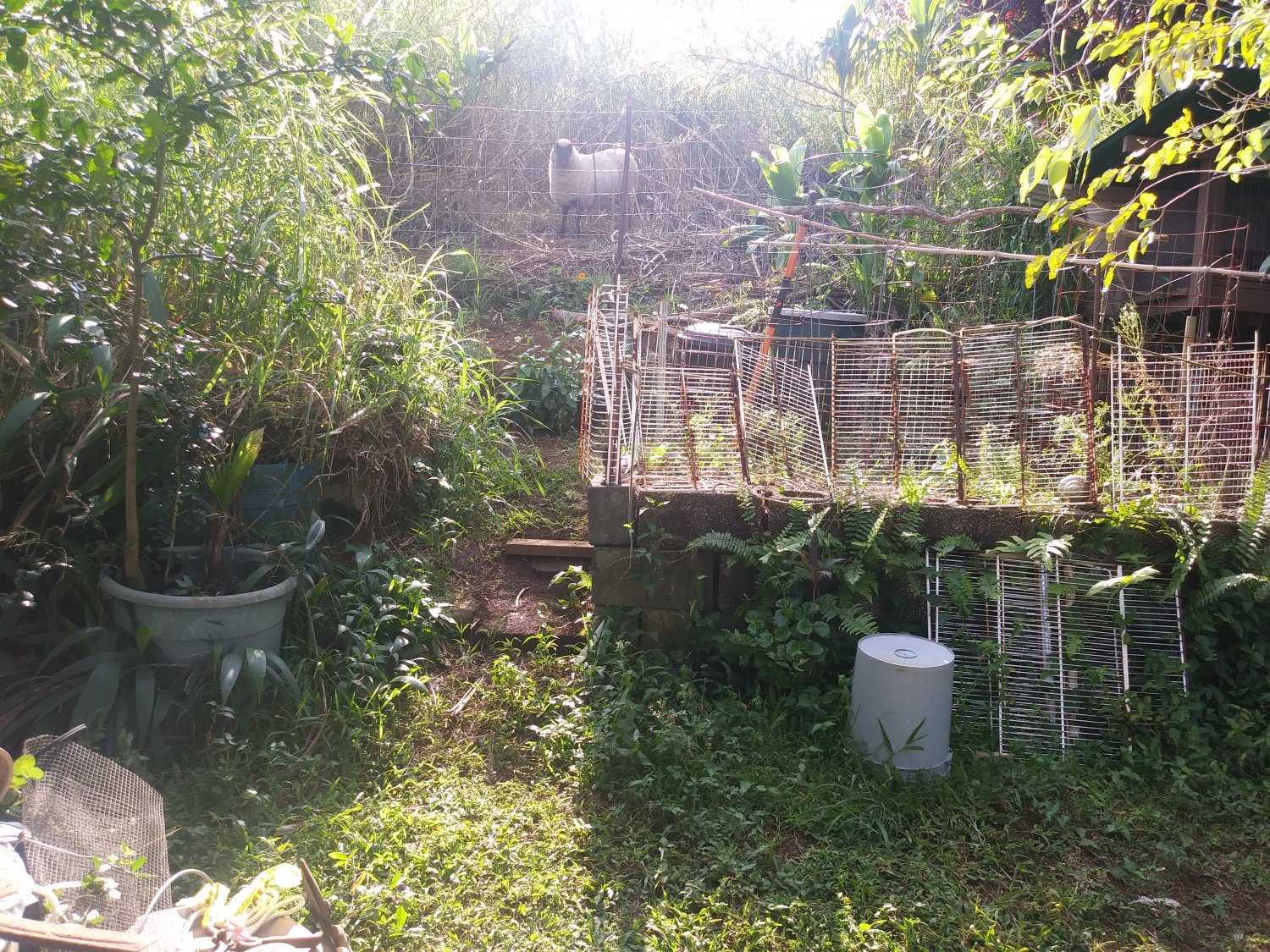
The grass used to be up to and over their fence, they've cleared it back and thinned it out but the Guinea/Cane/Elephant/Reznor grass is still not short. They've learned to look up for food and walk on the stems to bring the leafy parts down to where they can get them but there's still a lot of grass there.
The 'fence' of refrigerator racks around the garden isn't part of the sheep pasture. That's supposed to keep out chickens, but they've been flying over it and eating the lettuce so that's another project on the 'to do' list. The grass on the left side of the picture is another project. It needs to be flattened and another raised bed garden put in there to terrace the hillside as well as keep the grass from growing back there.